Posts

Showing posts with the label Updates

Delivery Optimization in Microsoft Endpoint Configuration Manager (ConfigMgr)

Image
Delivery Optimization can be a powerful tool to help manage your content. However, getting things configured can be confusing and daunting. Here I've broken out the steps to get you going. Client Settings 1.     BranchCache and PeerCache. a.    First, create a new Custom Device Settings and check the box for “Client Cache Settings” and “Delivery Optimization”. b.       BranchCache . To enable BranchCache on clients, set “Configure BranchCache” and “Enable BranchCache” to Yes and set the “Maximum BranchCache cache size (percentage of disk)”. (Default is 10). c.        PeerCache . To make the client a SuperPeer (PeerCache Source), set “Enable as peer cache source” to “Yes”. Note: SuperPeers should be clients that are newer (faster), always on devices, that are hard wired, and have plenty of hard drive space. Note: Build a WQL query to create and maintain a collection of SuperPeers. I.E., CPU, memory, free space, etc....

WSUS Products

Image
If you are trying to decide what Products to include in your WSUS settings, this is the article for you.  ConfigMgr and WSUS currently have a dozen Windows 10 “products” listed but the descriptions are lacking. Windows 10 and Later Drivers:  These are drivers that will be offered to all builds of Windows 10 all the time, excluding upgrade scenarios (i.e., via Orchestrator, DSM, or Device Manager). They will not download during a Dynamic Update (i.e., Windows 10 upgrading itself from build 1511 to 1607).    They should only include KBs for the current Win10 version. . Windows 10 and Later Upgrade & Servicing Drivers:  These are drivers that are offered in all Win10 scenarios (i.e., via Orchestrator, DSM, Device Manager, or during DU). They may include some KBs later win10 version and enable current win10 version to upgrade. . Windows 10 Anniversary Update and Later Servicing Drivers:   These drivers apply only to Window...

Windows 7 Clients Not Installing Updates

Image
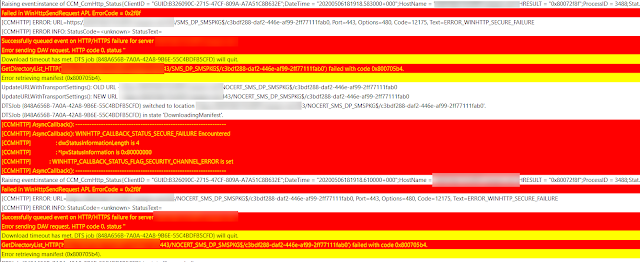
Ran across some Windows 7 systems that were not getting updates. I started down the normal troubleshooting path by looking at various logs. The logs mostly looked good. However, the datatransferservice.log was lit up like a Christmas tree! The log was full of all kinds of HTTP errors but these two stood out: WINHTTP_CALLBACK_STATUS_SECURE_FAILURE WINHTTP_CALLBACK_STATUS_FLAG_SECURITY_CHANNEL_ERROR After researching a bunch of IIS sites including this one , I finally narrowed it down to something with TLS. Turns out they had disabled TLS 1.0 on the MP but the client (Windows 7 SP1) did not support TLS 1.2. In order for a Windows 7 client to support TLS 1.2, you have to upgrade .NET and apply KB3140245 . This patch appears to be standalone and not part of any other cumulative. It can be found in the Microsoft Catalog . After installing the patch and rebooting, the client was then able to communicate with the MP and get the patches it needed. Good luck!

Windows 10 Upgrade - Panther Logs - Locations

Where the heck is the #($*@(*#$# panther logs? Logfile location Description $windows.~bt\Sources\Panther Log location before Setup can access the drive. $windows.~bt\Sources\Rollback Log location when Setup rolls back in the event of a fatal error. %WINDIR%\Panther Log location of Setup actions after disk configuration. %WINDIR%\Inf\Setupapi .log Used to log Plug and Play device installations. %WINDIR%\Memory.dmp Location of memory dump from bug checks. %WINDIR%\Minidump.dmp Location of log minidumps from bug checks. %WINDIR%\System32\Sysprep\Panther Location of Sysprep logs.

New Microsoft Office Customization Tool for Click-to-Run (Preview)

Office Customization Tool for Click-to-Run follows the Office 365 Support policy guidelines for Office 365 ProPlus Subscriptions. Agents and Engineers familiar with how to troubleshoot the manual creation of Configuration.xml for use with the Office Deployment Tool will easily be able to transfer that knowledge to this new tool. https://techcommunity.microsoft.com/t5/Office-365-Blog/Customizing-Office-365-ProPlus-using-the-Office-Customization/ba-p/141932

Importing Microsoft Hotfixes into SCUP 2011

Image
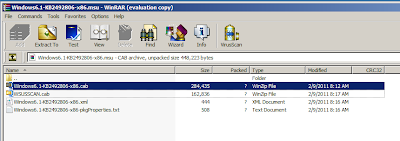
Extract only the .CAB file from the MSU (using WinRAR). In Windows 7 run iexpress.exe. Click Start and in the search box type "Iexpress.exe"                           Click Next on the “Welcome to IExpress 2.0” screen. Click Next on the “Package Purpose” Screen.   On the "Package Title" screen, name the package. I use the name of the CAB – i.e. :   Click Next on “Confirmation Prompt” & “License Agreement” screens. Click “Add” on the “Packaged Files” Screen and browse to the .CAB file you extracted earlier. Make note of the PATH where that .CAB file is located. You will need that. Click Next. On the “Install Program to Launch” screen you will put in the following string in the box next to "Install Program": dism.exe /online /add-package:”<PATH TO THE CAB>Windows6.1-KB2547244-x86.cab” /norestart Click Next. Click Next on the “Show Window”...